


Georgetown Democracy Initiative’s Second Democracy Dialogue Addressed Democratic Resilience
On October 19, 2026, the Georgetown Democracy Initiative (GDI) hosted a keynote lecture and panel discussion on democratic resilience around the world. The event – GDI’s second annual “Democracy Dialogue” – opened with remarks from College of Arts & Sciences (CAS) Dean David Edelstein, who embraced GDI’s move into CAS. GDI Director Diana Kapiszewski also outlined GDI’s mission: to expand research and teaching on democracy’s problems as well as its promise, to support democratic engagement at Georgetown, and to raise up young people’s voices.

Can Hungary Start a Democratic Cascade?
The keynote speaker was Princeton University Professor Kim Lane Scheppele, who received a Guggenheim Fellowship in 2024 for her work on democratic backsliding. She began by detailing a sobering pattern: since 1990, no democracy that experienced an autocratic episode has recovered for more than five years before sliding back toward autocracy. Hungary’s April 2026 election, a landslide defeat of Viktor Orbán, raises the question of whether that trend can finally be broken.
Scheppele traced how Hungary became a “competitive authoritarian” regime under Orbán. His government, including many lawyers, rewrote the constitution, captured the courts and independent institutions, attacked civil society, and rigged national elections. His centralization of power, despite being anti-democratic, was carried out legally, and Hungary became a model for would-be autocrats elsewhere, Scheppele argued.
Scheppele then considered Péter Magyar and the increasing power of his improvised Tisza party. Running for president in 2025-26 against gerrymandered districts, media saturation, and a weaponized state, Magyar focused his campaign on the immense corruption of the Orbán government. He walked across Hungary and utilized social media to amass a following and grow the “Tisza Islands,” a network of decentralized local political groups. In the April 2026 election, turnout reached nearly eighty percent, and Tisza won 141 of 199 seats in the parliament. In view of the overwhelming victor, Orbán conceded to Magyar.
Scheppele argued that the new government must act quickly and remove the rules that allowed for Orbán’s autocracy. With a two-thirds majority in the parliament, the new Hungarian government has the opportunity to amend the constitution. During the Q&A, Scheppele clarified that rule of law is necessary, but that it may be legitimate to break some laws that facilitate autocratic capture. Drawing comparisons to revolutions of 1848, she argued that Hungary’s reversal of an authoritarian regime could inspire other countries to reject democratic backsliding. However, she also noted that change often occurs only once things get bad enough for people to feel compelled to take action themselves.
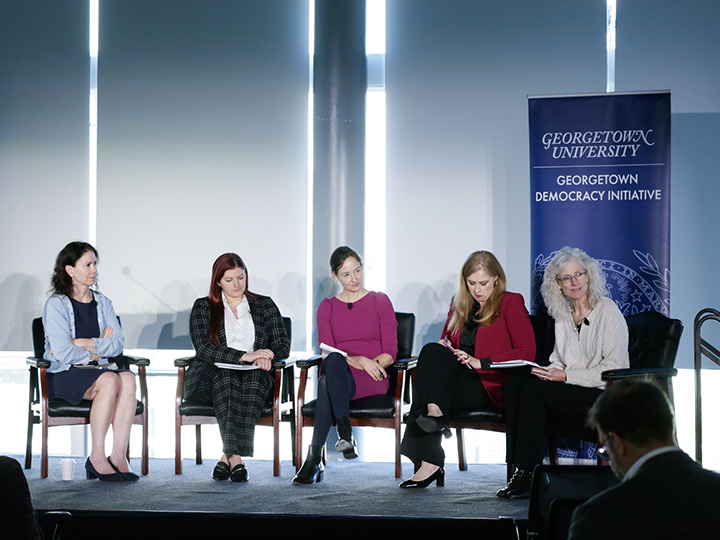
Panel Discussion: Resilience, Recovery, and Renewal
The keynote was followed by an expert panel featuring Barnard College Professor Sheri Berman , National Autonomous University of Mexico Professor Karolina Gilas, Carnegie Endowment for International Peace Senior Fellow Saskia Brechenmacher, and International Foundation for Electoral Systems Democratic Resilience Lab Director Cassandra Emmons, and moderated by Diana Kapiszewski. Panelists distinguished among democratic resilience, recovery, and renewal, and considered the challenges entailed in rebuilding after an authoritarian episode.
Berman observed that today’s challenge is distinctive from earlier regime changes because most backsliding regimes are hybrid rather than fully authoritarian, so reformers are not starting from scratch. She also stressed that leaders like Hungary’s Orbán and U.S. President Trump come to power through elections, and any recovery has to address the dissatisfaction that led voters to take a chance on them. Gilas argued that democratic erosion drives polarization rather than the reverse, and cautioned against comparing today’s cases too closely with the regimes that collapsed post-World War II.
The panel debated whether bending the rules to restore democracy could lead a new regime to become what it ostensibly opposes, and how to balance progress on democratic repair with addressing bread-and-butter issues. Panelists pointed to South Korea’s regime resilience and student movements in Serbia and elsewhere, which have prompted snap elections in five countries since 2022, as reasons for cautious optimism.