

.png)
AIDC and GDI Host Events to Address AI’s Intersections with Democracy
On March 25 and 26, 2026, the Georgetown Democracy Initiative (GDI) and Georgetown Initiative on Artificial Intelligence and Democratic Citizenship (AIDC), with support from the Georgetown Institute of Politics and Public Service (GU Politics), hosted two events addressing the intersection of democracy and artificial intelligence. The March 25 event, a two-panel discussion on “Making AI Work for the People” held on Georgetown University’s Capitol Campus, was followed by a roundtable on artificial intelligence and democracy on March 26 in the Healey Family Student Center on the Hilltop Campus.
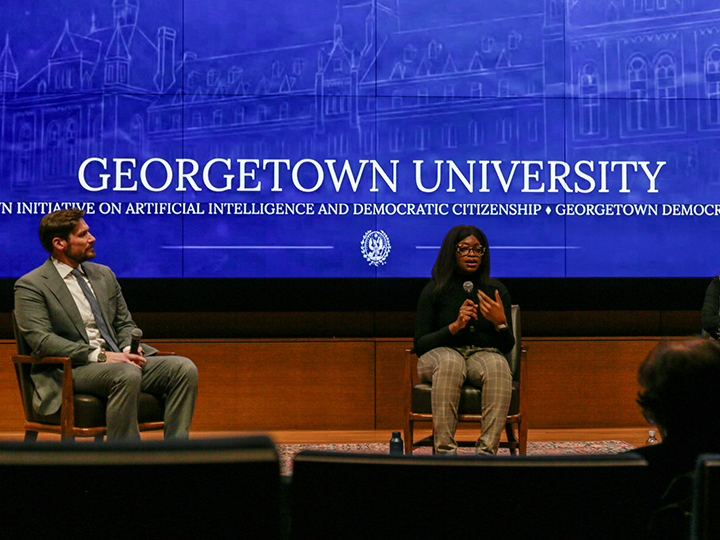
Making AI Work for the People
The first panel, moderated by Georgetown University’s Assistant Professor of Government and AIDC Founding Director Mark Fisher, explored international organizations’ response to AI. Panelists included Gabriela Ramos, architect of UNESCO's Recommendation on the Ethics of AI, and Chinasa T. Okolo, AI emerging technologies specialist at the UN Office for Digital and Emerging Technologies. The panelists offered their perspectives on the importance of popular agency in marshaling AI in support of democracy, sovereign AI usage, and AI’s role in geopolitical competition.
The second panel, moderated by Samuel Kimbriel, founding director of the Aspen Institute’s Philosophy and Society Initiative, focused on civil society’s response to AI. Panelists included Michele L. Jawando, CEO of the Omidyar Network, and Kim Daniels, director of the Georgetown University Initiative on Catholic Social Thought and Public Life. The panelists shared how their professional lives have shaped their perspectives on AI, and how AI and technology more generally have changed human relationships over the past few decades.
During the Q&A sessions, the audience and the moderators engaged with panelists, examining current AI governance models, the relationship between human dignity and AI policy development, and AI’s effect on civic and communal trust. The event reemphasized the evolving relationship between AI and democracy and raised new questions for academics, policymakers, and practitioners alike.
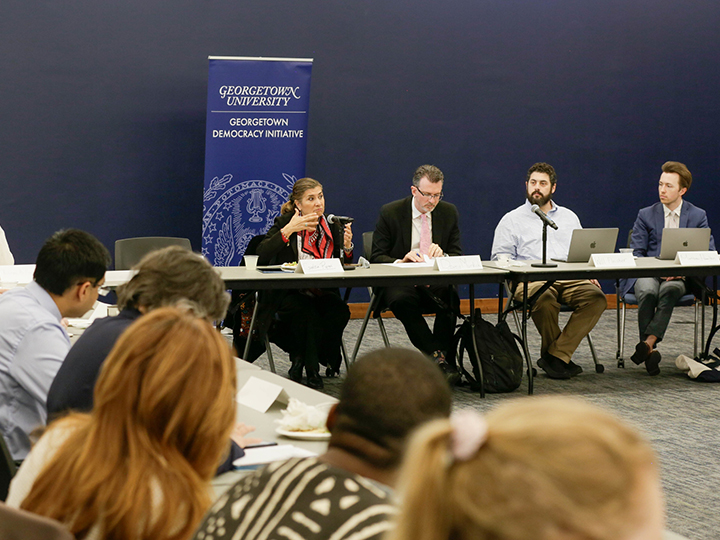
Discussing the Implications of AI for Democracy
The conversation continued the following day with a roundtable discussion . Roundtable presenters included Gabriela Ramos; Will Fleisher, assistant professor of philosophy and assistant research professor in the Center for Digital Ethics at Georgetown University; and Dewey Murdick,professor of the practice at Georgetown University.
Gabriela Ramos focused on how a successful democracy functions through the preservation of the information space, where people may inform themselves and engage in political exchange. She emphasized that as AI can erode trust within the information space, supporting the integrity of that space is especially important. Will Fleisher highlighted the importance of understanding AI systems and the socio-technical systems they are embedded in, who is building them, and how they are built, in order to address their opacity. He further discussed the need for democratic oversight of the development and deployment of AI systems.
Dewey Murdick emphasized preparing students to live in a world with AI, and how to work with it rather than against it. For example, he discussed how AI has the ability to reduce the cognitive load of research, allowing undergraduate students to tackle problems they could not before. All of the panelists highlighted the strength of a liberal arts education in supporting democracy and how it instills in students the ability to develop critical thinking and knowledge.
Following these opening remarks, roundtable attendees engaged in an open discussion, exploring key themes, unanswered questions, and implications for research, policy, and pedagogy relating to AI and democracy. Attendees raised questions on the impacts of AI on society, from educational to political systems. They considered what a democratically produced AI system would look like and the role of political institutions in regulating emerging technology. The discussion also focused on how AI can reduce trust in democracy, including spreading misinformation, hindering the ability to develop democratic communities, and degrading independent sources through generative AI and deepfakes. They also considered the future of AI including the consequences of AI being adopted at a large-scale across partisan and class lines. Roundtable attendees also mentioned some benefits of AI, including its potential role as a solution to decreasing trust in a democracy.
In all, the events highlighted how AI holds the potential to both threaten and enhance democracy, democratic citizenship, and democratic practices, and also showcased the knowledge and curiosity of Georgetown faculty and students about the intersection between technological evolution and political evolution around the globe.