

.png)
Friday, November 6, 2026
2:00 p.m. - 3:30 p.m. EST
Location: Lauinger Library Murray Room
Friday, November 6, 2026
2:00 p.m. - 3:30 p.m. EST
Location: Lauinger Library Murray Room
Expectations for the midterm elections on November 3, 2026 are that the Democratic Party will win control of the U.S. House of Representatives and possibly the Senate, setting up a divided government for the second half of President Donald Trump’s second term. On the Friday after the election, the Georgetown Democracy Initiative will host a discussion to evaluate how accurate those expectations were and take a clearer look at what the elections and their results mean for President Trump’s final two years in office.
This event is co-sponsored by the Georgetown Democracy Initiative and the M.A. in American Government Program at Georgetown University.
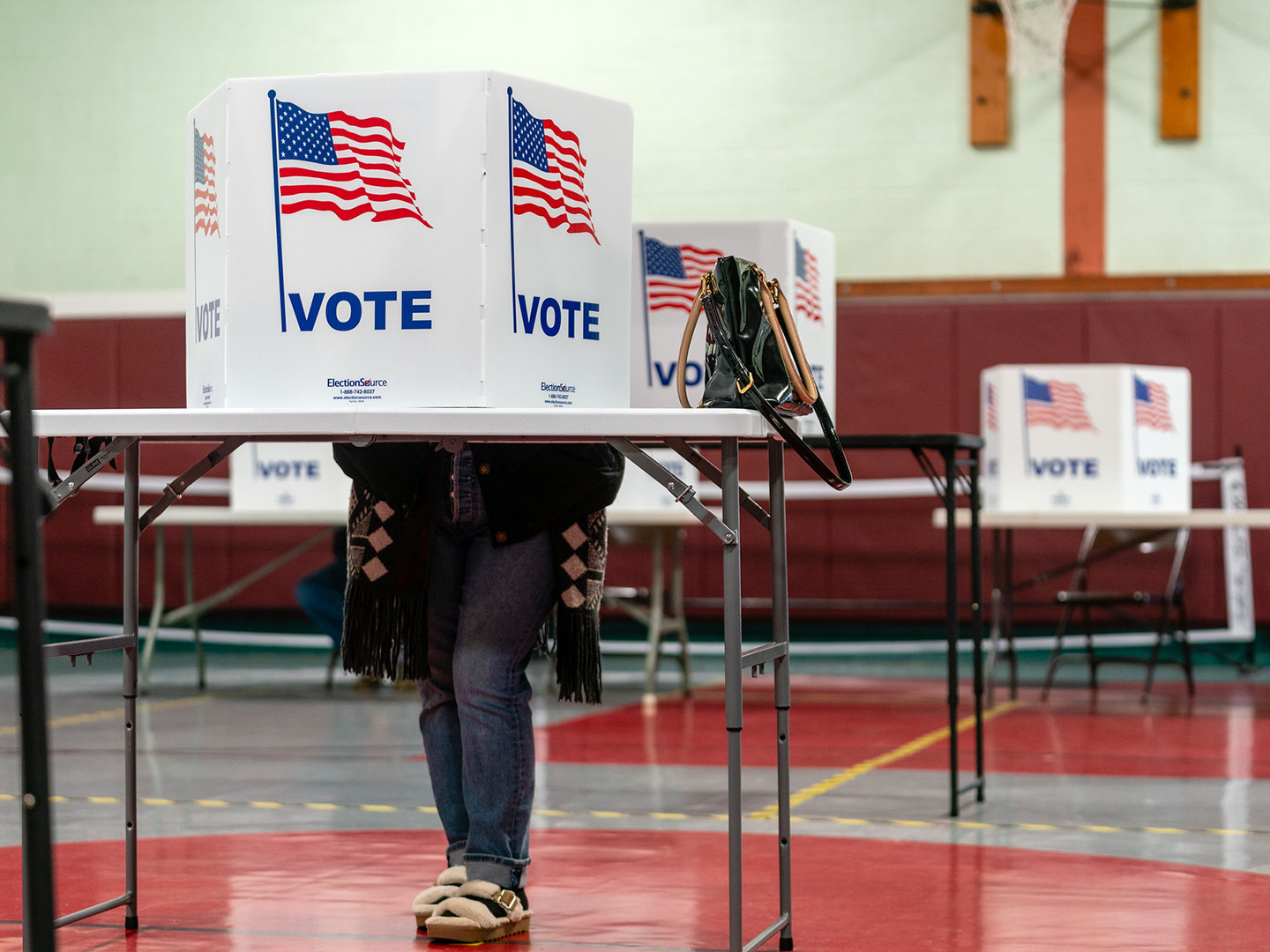
Photo courtesy of Flickr user Lorie Shaull
Natalie Jackson is founder and principal of Centerline Research and Strategy, a public opinion research and strategic advisory firm. She has spent two decades developing extensive expertise in survey research, methodology, and political polling. Her research on how people form opinions, as well as on the election polling and forecasting landscape, has appeared in peer-reviewed journals and edited volumes. She has a weekly column on data politics called “Leading Indicators” at National Journal and does additional writing on her “Stuck in the Middle” Substack. Prior to starting her own firm, she was a vice president at GQR, one of the leading Democratic polling firms. She has held leadership roles at the Public Religion Research Institute and at Just Capital. Earlier in her career, she held senior and management positions at the Marist Institute for Public Opinion and the Huffington Post. Natalie received her Ph.D. in political science from the University of Oklahoma and was a postdoctoral associate at Duke University. She holds a B.A. from West Texas A&M University.
Jamil Scott-Cummings is an assistant professor of political science in the Department of Government at Georgetown University. She earned her Ph.D. in political science from Michigan State University. Her research interests focus on the political behavior of elites and the mass public in the United States, with particular emphasis on how race and gender shape political decision-making. She uses various methodological strategies in her work, including surveys, experiments, and interviews, to capture how identity shapes political life. In addition, her work (with various co-authors) has been published in journals such as Politics, Groups & Identities, Journal of Race, Ethnicity & Politics, American Politics Research, and Journal of Politics. Her book, When and Where They Enter: Black Women’s Candidate Emergence at the State Level, is forthcoming from the University of Michigan Press in August 2027.
Michele Swers is professor of American government in the Department of Government at Georgetown University. Swers' research encompasses Congress, congressional elections, and women and politics. She has written two books about women, representation, and policymaking in the United States: The Difference Women Make (2002) on the House of Representatives and Women in the Club (2013) on the Senate. She also co-authors the textbook Women and Politics: Paths to Power and Political Influence, 5th Edition (with Julie Dolan, Melissa Deckman, and Paru Shah). Swers’ work on bill sponsorship, campaign finance, and congressional policymaking on women, children, and family issues appears in multiple academic journals and book chapters. Her current research examines the history of party contestation over the family and the evolution of Democratic and Republican proposals to address caregiving issues including child care, family leave, and the child tax credit.
Hans Noel (moderator) is associate professor of government and director of research of the Georgetown Democracy Initiative at Georgetown University. His research is on political coalitions, political parties, and ideology, with a focus on the United States. He is the author or co-author of four books, including Political Ideologies and Political Parties in America (2013) and The Party Decides: Presidential Nominations Before and After Reform (with Martin Cohen, David Karol, and John Zaller, 2008). His work has appeared in the American Political Science Review and the Journal of Politics and Perspectives on Politics, among other journals.